
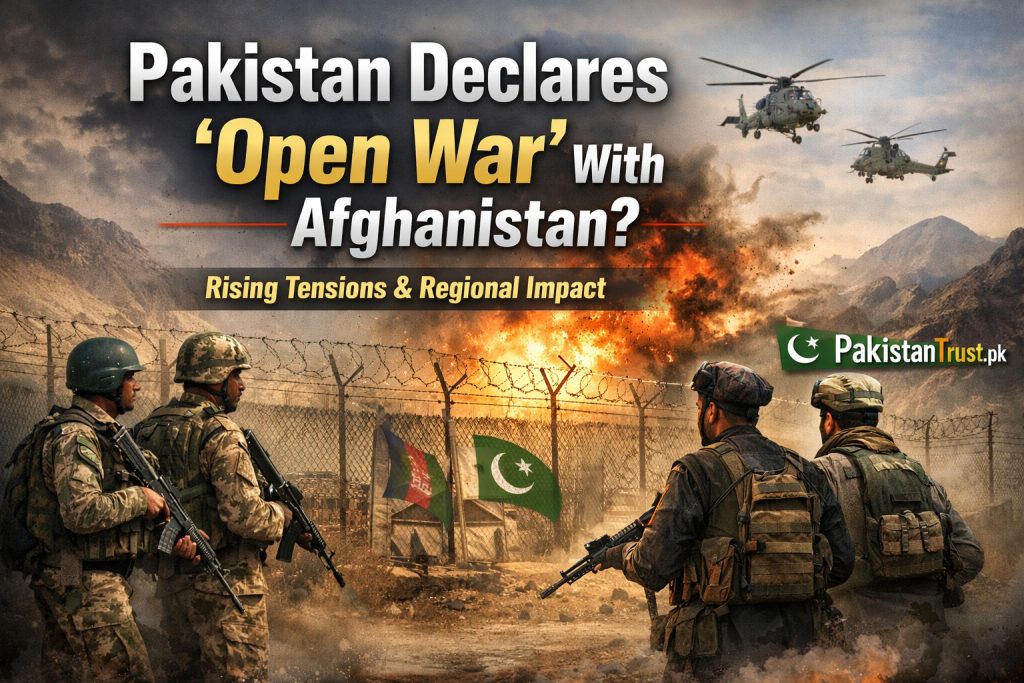
In recent days, headlines and social media posts have circulated dramatic claims that Pakistan has declared an “open war” with Afghanistan. Such phrases instantly create fear, confusion, and emotional reactions—especially in a region that has already experienced decades of instability. But what does this claim really mean? Is it an official declaration of war, or is it a reflection of rising tensions along the border?
This article takes a balanced and human-centered look at the situation. We will explore the background of Pakistan–Afghanistan relations, the reasons behind the current tension, the official positions of both governments, and what it could mean for the people of both countries and the wider region.
1:- Historical Background of Pakistan–Afghanistan Relations:
Pakistan and Afghanistan share more than just a border. The two countries are connected through culture, religion, trade, and family ties. Millions of Afghan refugees have lived in Pakistan over the years, especially since the Soviet invasion of Afghanistan in 1979. Cities like Peshawar and Quetta have hosted Afghan communities for decades.
However, despite close people-to-people connections, political relations have often been tense. A key issue is the Durand Line, the 2,640-kilometer border between the two countries. Pakistan recognizes it as the official international border, but many Afghan leaders have historically questioned its legitimacy. This disagreement has led to mistrust and periodic clashes.
Over the years, security concerns have also played a major role. Pakistan has repeatedly accused militant groups of using Afghan soil to carry out attacks inside Pakistan. On the other hand, Afghan authorities have sometimes accused Pakistan of interfering in their internal affairs.
2:- What Does “Open War” Really Mean?
The phrase “open war” is powerful and alarming. In international law and diplomacy, a formal declaration of war is a serious step that involves official government announcements and mobilization of full-scale military operations.
As of now, there has been no official, formal declaration of war by Pakistan against Afghanistan in the traditional legal sense. Instead, the phrase seems to reflect escalating tensions, military responses to cross-border incidents, and strong political statements.
In modern times, many conflicts occur without formal declarations. Countries may engage in limited military strikes, border operations, or targeted actions while avoiding the label of “war.” Therefore, it is important to separate emotional headlines from official government positions.
3:- Recent Border Clashes and Security Concerns:
The primary source of tension between Pakistan and Afghanistan has been cross-border militancy. Pakistan has faced a rise in attacks in its border provinces, particularly Khyber Pakhtunkhwa and Balochistan.
Pakistani officials have claimed that certain militant groups are operating from Afghan territory. Islamabad has repeatedly urged Afghan authorities to take action against these groups. When such attacks increase, Pakistan sometimes responds with military operations near the border.
These operations, in turn, create strong reactions from Afghan authorities, who see them as violations of sovereignty. The result is a cycle of accusations, counter-accusations, and sometimes military exchanges.
It is this pattern of escalation that has led some media outlets to use the term “open war.”
4:- Political Statements and Diplomatic Strain:
Strong political language often makes situations appear worse than they are. When government officials speak about “decisive action,” “retaliation,” or “defending national security at all costs,” the public may interpret it as preparation for war.
Pakistan has emphasized that its actions are aimed at protecting its citizens from terrorism. Afghan authorities, meanwhile, have called for dialogue and respect for sovereignty.
Diplomatic channels usually remain active even during tense moments. Ambassadors, military officials, and intelligence representatives often communicate behind the scenes to prevent misunderstandings from turning into full-scale conflict.
5:- Impact on Ordinary Citizens:
Whenever tensions rise between neighboring countries, it is ordinary people who suffer the most. Cross-border trade slows down, travel becomes restricted, and families living on both sides of the border face uncertainty.
Afghan traders depend on access to Pakistani ports for international trade. Pakistani businesses also rely on regional connectivity through Afghanistan for trade with Central Asia. Any prolonged conflict could damage economic opportunities for both nations.
Refugees are another sensitive issue. Pakistan has hosted millions of Afghan refugees over the decades. Increased tension may complicate humanitarian efforts and create fear among displaced communities.
6:- Regional and Global Implications:
Pakistan and Afghanistan are located in a strategically important region. Any serious conflict between the two countries would not remain isolated. Neighboring countries such as Iran, China, and Central Asian states would closely monitor developments.
China has major investments in Pakistan through the China-Pakistan Economic Corridor (CPEC). Instability near Pakistan’s western border could impact regional economic projects.
The international community generally encourages dialogue and peaceful resolution. Global powers understand that another major conflict in South Asia would create humanitarian and security challenges far beyond the region.
7:- Is a Full-Scale War Likely?
While tensions are serious, a full-scale war between Pakistan and Afghanistan remains unlikely for several reasons:
- Economic Constraints: Both countries face economic challenges and cannot afford a prolonged war.
- International Pressure: The global community strongly discourages open conflict.
- Mutual Interests: Trade, refugee management, and regional stability require cooperation.
- Military Calculations: Large-scale war would be costly and unpredictable for both sides.
Most border conflicts in recent years have remained limited and controlled, even when rhetoric was strong.
8:- The Role of Media and Social Platforms:
In today’s digital age, information spreads quickly—often without verification. A single dramatic headline can create panic across social media platforms. It is important for readers to rely on credible news sources and official government statements before forming conclusions.
Sometimes, phrases like “open war” are used to attract attention rather than accurately describe the situation. Responsible journalism plays a critical role in maintaining calm and preventing misinformation.
9:- The Path Forward: Dialogue and Cooperation:
The only sustainable solution to long-term tension is dialogue. Both Pakistan and Afghanistan share deep historical, cultural, and economic ties. Peaceful relations would benefit millions of people on both sides of the border.
Key steps that could improve the situation include:
- Regular diplomatic engagement
- Joint border management mechanisms
- Intelligence sharing against militant groups
- Economic cooperation initiatives
- Confidence-building measures between military leadership
When communication channels remain open, even serious disagreements can be managed without turning into war.
Conclusion
The claim that Pakistan has declared “open war” with Afghanistan reflects rising tensions and security concerns rather than a formal declaration of war. While border clashes and strong political language have increased anxiety, a full-scale war appears unlikely at this stage.
Both countries face internal economic and social challenges that require stability rather than conflict. The people of Pakistan and Afghanistan share history, culture, and deep connections that go beyond political disagreements.
In times of uncertainty, calm analysis is more important than emotional reactions. Peace, dialogue, and cooperation remain the most practical and hopeful path forward for the region.
Pakistantrust.pk Opinion:
In my opinion, the phrase “open war” between Pakistan and Afghanistan sounds more dramatic than the actual situation. While tensions and border clashes are serious and cannot be ignored, turning every escalation into a war narrative only increases fear among people. Both countries have suffered enough due to decades of instability, and another conflict would only damage economic growth and regional peace. Instead of aggressive rhetoric, leaders on both sides should focus on dialogue, security cooperation, and diplomatic engagement. Stability is in the best interest of Pakistan, Afghanistan, and the wider region. Peaceful solutions must always come before confrontation.