
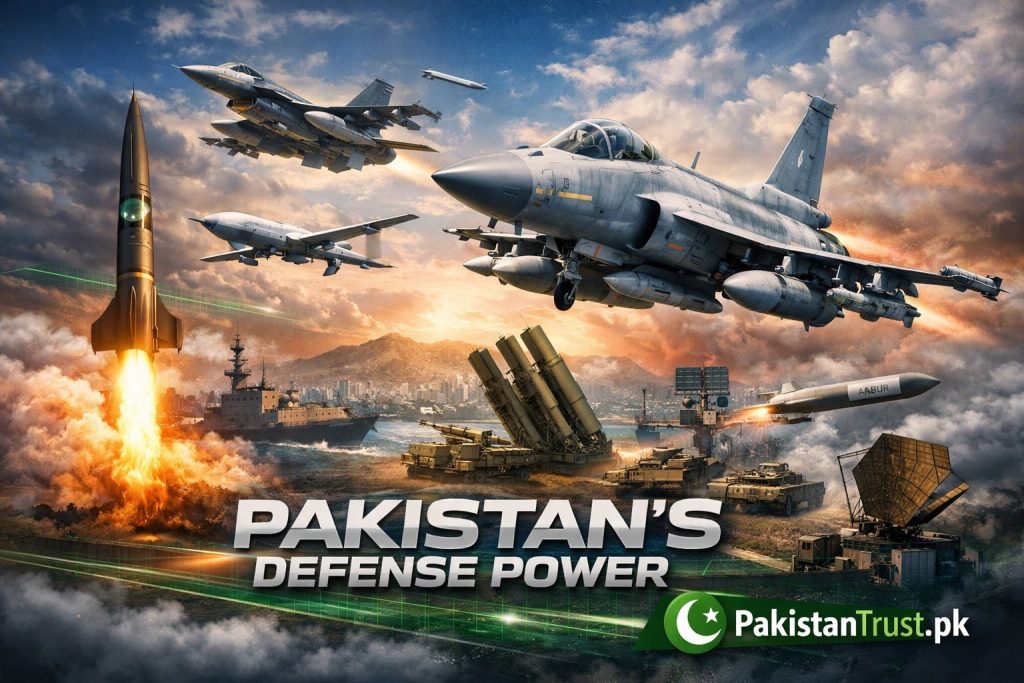
Pakistan has always given strong importance to national defense. Due to its geographical location and regional challenges, the country has focused on building a modern and capable military force. Among all branches of the armed forces, the Pakistan Air Force (PAF) plays a major role in protecting the country’s airspace. Over the years, Pakistan has upgraded its fighter jets, missile systems, and defense technology to meet modern warfare standards.
This article explores Pakistan’s fighter jets, advanced weapons systems, missile technology, and the future of its defense capabilities.
1:- Pakistan Air Force – A Symbol of Strength:
The Pakistan Air Force (PAF) was established in 1947 after independence. Since then, it has developed into one of the most professional air forces in the region. The PAF is known for its discipline, pilot training standards, and modern combat aircraft.
The Air Force is responsible for:
- Protecting Pakistan’s airspace
- Supporting ground and naval forces
- Conducting surveillance and reconnaissance
- Participating in international peace missions
Over the years, the PAF has modernized its fleet with advanced multi-role fighter jets.
2:- JF-17 Thunder – Pakistan’s Pride:
One of Pakistan’s most important fighter jets is the JF-17 Thunder. It is a multi-role combat aircraft developed jointly by Pakistan and China. The project allowed Pakistan to reduce dependence on foreign suppliers and build its own defense industry.
Key Features of JF-17:
- Multi-role capability (air-to-air and air-to-ground)
- Modern radar systems
- Beyond Visual Range (BVR) missile capability
- Cost-effective maintenance
- Advanced avionics
The latest Block III version includes modern radar technology and improved combat capabilities. The aircraft has also been exported to friendly countries, which shows international confidence in Pakistan’s defense manufacturing.

3:- F-16 Fighting Falcon – Advanced Combat Power:
Another major aircraft in Pakistan’s fleet is the F-16 Fighting Falcon. These jets were acquired from the United States and are known worldwide for their combat performance.
The F-16 is capable of:
- Precision air strikes
- Air superiority missions
- Night operations
- Advanced targeting systems
These jets played a significant role in different operations, proving their effectiveness in real combat situations. Pakistan has upgraded its F-16 fleet with modern systems to keep them relevant in modern warfare.

4:- Mirage Aircraft – Reliable and Proven:
Pakistan also operates the Dassault Mirage III and Dassault Mirage 5 aircraft. These jets were acquired from France and have been upgraded locally with modern avionics and weapons systems.
Although they are older platforms, Pakistan has successfully modified them for precision strike roles. This shows the country’s technical ability to extend the life of its aircraft through local engineering.
5:- Missile Systems – Strategic Deterrence:
Apart from fighter jets, Pakistan has developed a strong missile program. This program plays an important role in maintaining strategic balance in the region.
Shaheen Missile Series
The Shaheen missile is a series of ballistic missiles developed by Pakistan. These missiles are capable of carrying conventional and strategic payloads over long distances.
Babur Cruise Missile
The Babur missile is a ground-launched cruise missile. It is designed for precision targeting and can fly at low altitudes to avoid radar detection.
These missile systems strengthen Pakistan’s defensive posture and serve as a deterrent rather than an offensive threat.

6:- Air Defense Systems:
Air defense is equally important. Pakistan has improved its radar coverage and surface-to-air missile systems to detect and neutralize aerial threats.
The country has also inducted the HQ-9 long-range air defense system, which enhances its ability to protect strategic locations from aerial attacks.
Air defense works together with fighter jets to create a layered protection system.
7:- Naval Aviation and Drones:
Modern warfare is not limited to fighter jets. Pakistan is also investing in:
- Unmanned Aerial Vehicles (UAVs)
- Surveillance drones
- Maritime patrol aircraft
Drones provide real-time intelligence and reduce risks to pilots. These technologies improve situational awareness and border security.

8:- Indigenous Defense Production:
Pakistan has made major progress in local defense production through organizations like the Pakistan Aeronautical Complex (PAC). This facility plays a key role in assembling and upgrading fighter jets.
Local production offers several benefits:
- Reduced dependency on foreign suppliers
- Lower maintenance cost
- Technology transfer and skill development
- Job creation
The development of the JF-17 is a strong example of Pakistan’s growing defense industry.
9:- Training and Pilot Excellence:
Modern jets are only effective if pilots are highly trained. The Pakistan Air Force focuses heavily on pilot training, simulation exercises, and joint military drills with friendly countries.
Training includes:
- Advanced flight simulators
- Combat maneuver practice
- Electronic warfare exercises
- International joint exercises
This professional approach strengthens operational readiness.
10:- Future of Pakistan’s Air Power:
Pakistan continues to modernize its air force. Discussions about acquiring new generation aircraft and upgrading existing fleets are ongoing. The country is focused on:
- Improving radar systems
- Integrating advanced weapons
- Expanding drone capabilities
- Strengthening cyber and electronic warfare systems
Defense modernization is seen as a long-term strategy to ensure national security.
11:- Regional Balance and Defensive Strategy:
It is important to understand that Pakistan describes its defense policy as defensive in nature. The aim is to maintain strategic balance and prevent conflict through deterrence.
Military strength often acts as a stabilizing factor in sensitive regions. By maintaining a capable air force and missile program, Pakistan seeks to ensure that no external threat compromises its sovereignty.
12:- Conclusion:
Pakistan’s fighter jets and weapons systems reflect years of development, strategic planning, and technological progress. From the locally developed JF-17 Thunder to advanced missile systems like Shaheen and Babur, the country has built a diversified defense structure.
The Pakistan Air Force continues to evolve with modern equipment and professional training. Indigenous production and technological advancement show that Pakistan is moving toward greater self-reliance in defense matters.
While military strength is important, long-term peace and regional stability remain equally essential. A strong defense system provides security, but diplomacy and cooperation ensure lasting peace.
Pakistantrust.pk Opinion on Pakistan’s Defense Strength.
Pakistan’s defense system, especially the Pakistan Air Force, reflects a balanced approach between strength and responsibility. With modern fighter jets like the JF-17 Thunder and advanced missile systems, the country has built a strong deterrent capability. However, true power lies not only in weapons but in stability, strategy, and wise leadership. A capable defense force ensures national sovereignty and discourages aggression, but long-term peace depends on diplomacy and regional cooperation. Pakistan’s growing focus on indigenous production shows confidence and self-reliance, which can support both national security and technological progress in the future.