
The currency of Pakistan is more than just paper notes and metal coins. It reflects the country’s economic strength, trade performance, political stability, and global relationships. The Pakistani Rupee (PKR) plays a central role in daily life — from buying groceries in local markets to paying international trade bills.
In this detailed, human-friendly guide, we’ll explore the history, structure, challenges, and future of Pakistan’s currency in a simple and easy-to-read way.
1. A Brief History of the Pakistani Rupee:
After independence in 1947, Pakistan began using its own currency instead of the Indian rupee. The State Bank was established to manage monetary policy and issue currency.
Today, the State Bank of Pakistan controls:
- Printing of currency notes
- Issuance of coins
- Interest rate policies
- Inflation control
- Exchange rate management
Over the decades, the rupee has gone through multiple phases — from relative stability in early years to devaluation periods due to economic pressures.

2. Structure of the Pakistani Currency:
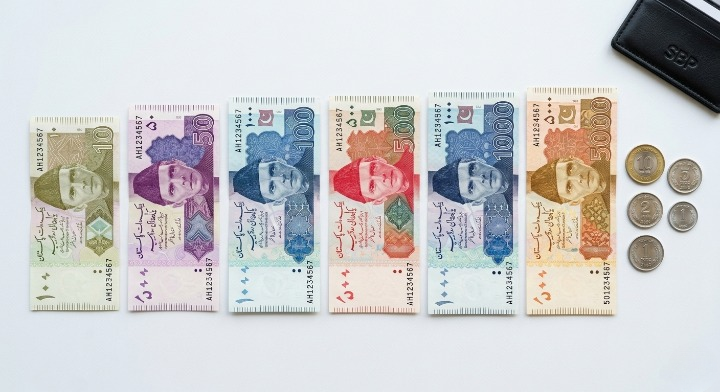
The Pakistani Rupee is divided into 100 paisa, although paisa coins are no longer commonly used.
Common Currency Notes:
- Rs. 10
- Rs. 20
- Rs. 50
- Rs. 100
- Rs. 500
- Rs. 1000
- Rs. 5000
Each note carries images of national leaders and landmarks, mainly featuring Quaid-e-Azam Muhammad Ali Jinnah.
Coins in Circulation:
- Rs. 1
- Rs. 2
- Rs. 5
- Rs. 10
3. What Determines the Value of the Rupee?
The value of PKR depends on several key factors:
1. Supply and Demand
If demand for dollars increases (for imports), the rupee weakens. If exports grow, the rupee strengthens.
2. Inflation
Higher inflation reduces purchasing power and weakens the currency.
3. Foreign Reserves
When foreign exchange reserves are low, currency pressure increases.
4. Political and Economic Stability
Stable governance builds investor confidence.
5. International Loans and Agreements
Programs with institutions like the International Monetary Fund and the World Bank often impact exchange rates.
4. Major Challenges Facing the Pakistani Rupee:
Pakistan’s currency has faced several economic challenges in recent years:
Trade Deficit
Pakistan imports more than it exports. This creates pressure on foreign reserves.
Energy Imports
High oil prices globally increase the need for dollars.
External Debt
Repayment of foreign loans affects the rupee’s stability.
Inflation
Rising prices reduce local purchasing power and weaken confidence.

5. Impact of Rupee Devaluation on Citizens:
When the rupee loses value:
- Imported goods become expensive
- Fuel prices increase
- Inflation rises
- Businesses face higher production costs
However, there is also a positive side:
- Exporters benefit
- Overseas Pakistanis sending remittances get better conversion rates
- Tourism may become cheaper for foreigners
So, currency movement affects different groups in different ways.
6. Role of Remittances in Strengthening the Rupee:
Millions of overseas Pakistanis send money back home every year. These remittances play a vital role in:
- Supporting families
- Boosting foreign reserves
- Stabilizing the exchange rate
7. Pakistan’s Trade and Economic Projects:
Large-scale projects like the China-Pakistan Economic Corridor aim to improve infrastructure, energy supply, and trade connectivity. If successful, such projects can:
- Increase exports
- Attract foreign investment
- Improve GDP growth
- Strengthen the rupee in the long term
Economic growth directly influences currency strength.

8. Digital Banking and the Future of Currency:
Pakistan is moving toward digital financial systems:
- Mobile banking
- Online transfers
- Digital wallets
- Branchless banking
These developments reduce reliance on physical cash and increase transparency in the financial system.
9. Comparison with Other Regional Currencies:
Compared to some neighboring countries, the rupee has experienced higher volatility. However, exchange rates fluctuate globally, and even strong economies face currency pressures due to global events.
Global factors like:
- Oil prices
- US interest rates
- International conflicts
- Supply chain disruptions
all impact emerging market currencies, including PKR.

10. Government Measures to Stabilize the Rupee:
Authorities have implemented several strategies:
- Tight monetary policy
- Increasing interest rates
- Controlling imports
- Encouraging exports
- Negotiating international financial programs
These measures aim to balance economic growth and currency stability.
Future Outlook of the Pakistani Rupee.
The future of Pakistan’s currency depends on:
- Political stability
- Export growth
- Industrial expansion
- Foreign investment
- Sustainable economic reforms
If structural reforms continue and exports increase, the rupee can gradually stabilize and strengthen over time.
Economic recovery is a long-term process, not an overnight change. Strong institutions, policy consistency, and investor confidence are key to a stable currency.
Conclusion:
The Pakistani Rupee is not just a currency — it is a reflection of Pakistan’s economic journey. From independence to modern digital banking, the rupee has evolved alongside the nation’s growth.
While challenges remain, opportunities also exist. With consistent economic reforms, improved exports, and global cooperation, Pakistan’s currency can achieve greater stability in the coming years.
Understanding how currency works helps citizens make smarter financial decisions — whether saving, investing, or planning for the future.
Pakistantrust.pk Opinion on Pakistan’s Currency .
Pakistan’s currency journey reflects the broader economic realities of Pakistan. The value of the Pakistani Rupee is closely connected to political stability, exports, inflation control, and policy decisions taken by institutions like the State Bank of Pakistan. While recent years have brought economic pressure and exchange rate challenges, there is still strong potential for recovery. If structural reforms continue, exports grow, and foreign investment increases, the rupee can gradually stabilize. In my opinion, long-term consistency in economic planning is the key to building confidence and strengthening Pakistan’s financial future.